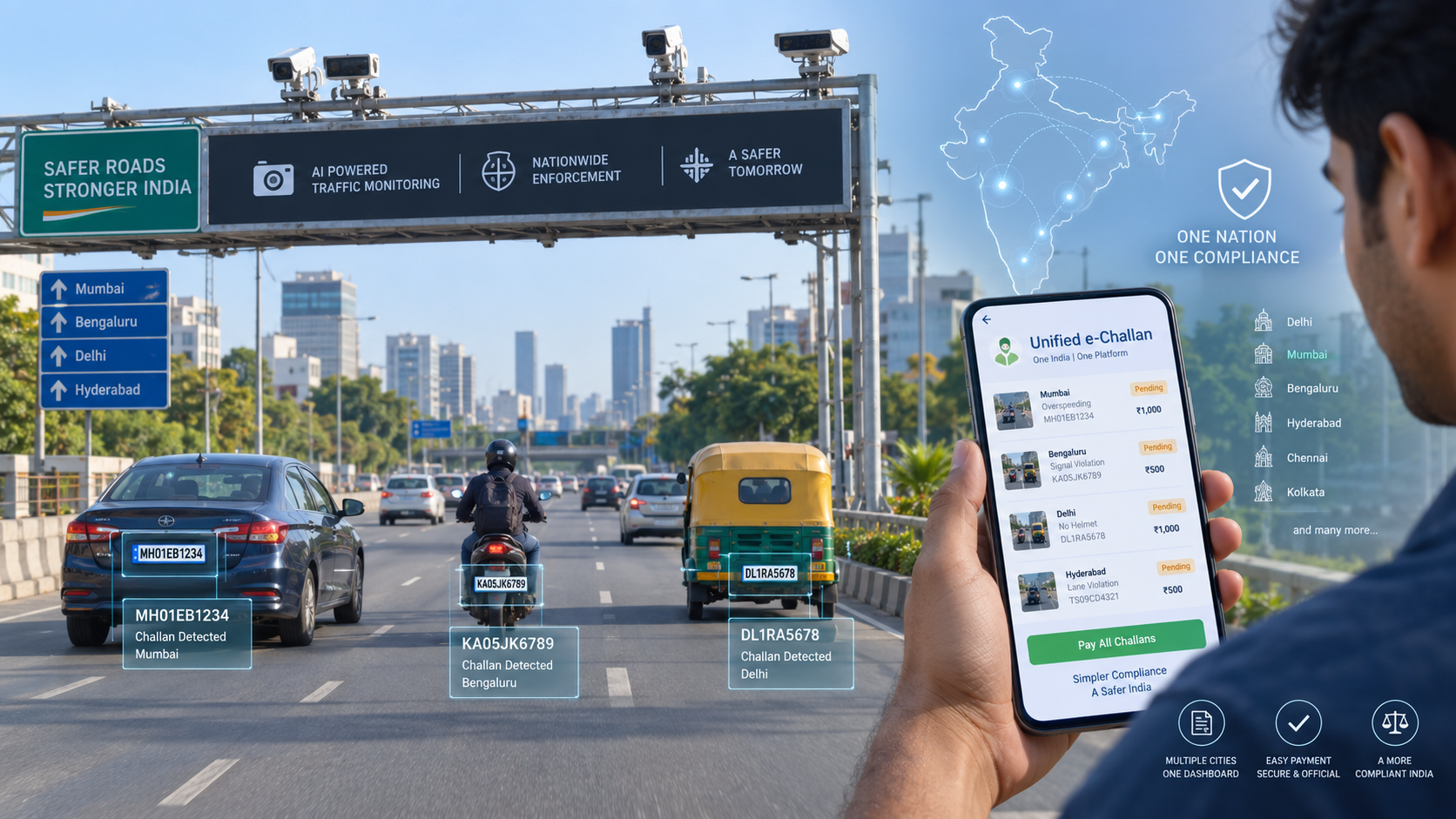
India’s traffic enforcement system is moving steadily toward a more connected digital framework. What was once a collection of local traffic records is increasingly being linked through technology, allowing vehicle and violation information to move across jurisdictions.
This shift is often described in public discussions as “One Nation, One Challan.” While it is important to understand that this is not simply one physical challan system replacing every state-level process, the broader direction is clear: digital traffic enforcement is making it easier to identify, record, track, and manage violations across India.
For drivers, this means traffic compliance is becoming more important than ever.
From Local Records to Connected Enforcement
Traditionally, traffic enforcement was largely experienced at the city or state level. A driver might receive a paper challan from a traffic officer and deal with the matter through a local process.
Digital systems have changed that experience. Electronic challans can connect a violation with vehicle registration and driving-related records. Camera-based enforcement can also identify offences without requiring an officer to stop the vehicle.
This creates a more connected enforcement environment where a driver's traffic history can become easier for authorities to monitor.
What Unified Digital Enforcement Actually Means
The idea behind unified traffic enforcement is relatively simple: different enforcement and transport systems should be able to exchange relevant information more efficiently.
For vehicle owners, this can mean:
- Traffic violations are recorded electronically.
- Vehicle details can be matched with registration records.
- Camera-detected offences can generate digital challans.
- Challan information can be accessed through online systems.
- Payment and dispute processes can increasingly be handled digitally.
- Authorities can maintain better records of repeated violations.
The objective is not merely to collect fines. Better information sharing can also improve enforcement consistency and encourage compliance.
Why Drivers Are Feeling the Change
A major difference is that traffic enforcement is becoming less dependent on physical interaction with traffic police.
A driver may not be stopped for:
- Speeding
- Signal violations
- Certain parking violations
- Helmet-related offences
- Seat belt violations
- Other electronically detectable offences
Instead, cameras or other authorised systems may record the incident. This means drivers cannot assume that avoiding a roadside stop means avoiding a traffic violation record.
Cross-State Travel and Traffic Compliance
India has a highly mobile population. People regularly drive between cities and states for work, business, tourism, and transportation.
A connected digital enforcement environment can make vehicle compliance more relevant for such travellers. A vehicle registered in one state may be detected for a traffic violation in another location. Digital systems can make it easier to associate the violation with the relevant vehicle record.
For drivers, this reinforces a simple principle: traffic compliance does not stop at the state border.
Commercial Fleets Face a Bigger Challenge
The impact can be particularly significant for transport companies, logistics operators, taxi businesses, and other commercial fleet owners.
Managing a single vehicle's challan may be relatively easy. Managing dozens or hundreds of vehicles is different.
Fleet operators need to monitor:
- Multiple vehicle registrations
- Driver compliance
- Pending challans
- Insurance validity
- Permits
- Fitness requirements
- Pollution-related documentation
- Licence status
- Repeated traffic violations
A unified digital environment can make information easier to track, but it also means businesses need stronger internal compliance systems.
What Happens When a Driver Ignores a Digital Challan?
Digital enforcement makes it increasingly difficult to treat a challan as a temporary inconvenience. An unresolved challan can remain associated with the relevant vehicle or driver record and may require action through the applicable payment or legal process.
Instead of waiting until a problem becomes urgent, vehicle owners should periodically check their traffic records and resolve genuine violations promptly.
If a challan is believed to be incorrect, the better approach is to use the prescribed dispute mechanism rather than simply leaving it unpaid.
Digital Enforcement Does Not Remove Driver Rights
Technology may change how violations are detected, but it does not mean drivers lose their ability to question an incorrect record.
A vehicle owner should carefully examine:
- Registration details
- Date and time
- Location
- Alleged offence
- Available evidence
- Challan status
If there is a genuine discrepancy, relevant evidence should be preserved and the matter should be raised through the applicable process.
For complicated cases involving disputed evidence, repeated offences, vehicle seizure, licence-related consequences, or court proceedings, professional legal guidance may be appropriate.
A New Compliance Mindset for Drivers
The biggest change may not be technological at all. It is behavioural.
In the past, some drivers viewed traffic compliance primarily through the possibility of being stopped by a police officer. Digital enforcement changes that mindset.
Today, responsible compliance means:
- Following speed limits even when no officer is visible.
- Stopping at traffic signals.
- Wearing required safety equipment.
- Maintaining valid vehicle documents.
- Parking only where permitted.
- Checking electronic challan records.
- Resolving genuine violations promptly.
- Challenging incorrect violations through proper channels.
The road itself is increasingly becoming part of the digital enforcement network.
What Drivers Should Do in 2026
Vehicle owners can take a proactive approach by maintaining accurate records and periodically checking their challan status through authorised services.
It is also important to keep registration, insurance, licence, and other applicable documents updated.
Drivers should be especially cautious about fraudulent challan messages. A message claiming that an urgent payment is required should not automatically be trusted. Verify the information through an official source before sharing personal or financial information.
The Road Ahead
India's transition toward technology-led traffic management is likely to continue. Better connectivity between transport databases, enforcement systems, cameras, and digital services can make traffic regulation more systematic.
For drivers, however, the fundamental rule remains unchanged: follow traffic laws and take responsibility for your vehicle's compliance.
“One Nation, One Challan” should therefore be understood less as a single nationwide fine collection mechanism and more as part of India's broader movement toward integrated digital traffic enforcement.
Final Takeaway
The growth of unified digital traffic enforcement is changing how violations are detected and managed in India. Drivers can no longer rely on the absence of a roadside traffic stop as an indication that everything is clear.
In 2026, responsible vehicle ownership increasingly means staying aware of your digital traffic records, maintaining valid documents, following road regulations, and acting promptly when a challan appears.
Technology may be changing the enforcement process, but the responsibility remains with every driver to understand the rules, drive safely, and address traffic-related issues through the proper channels.
