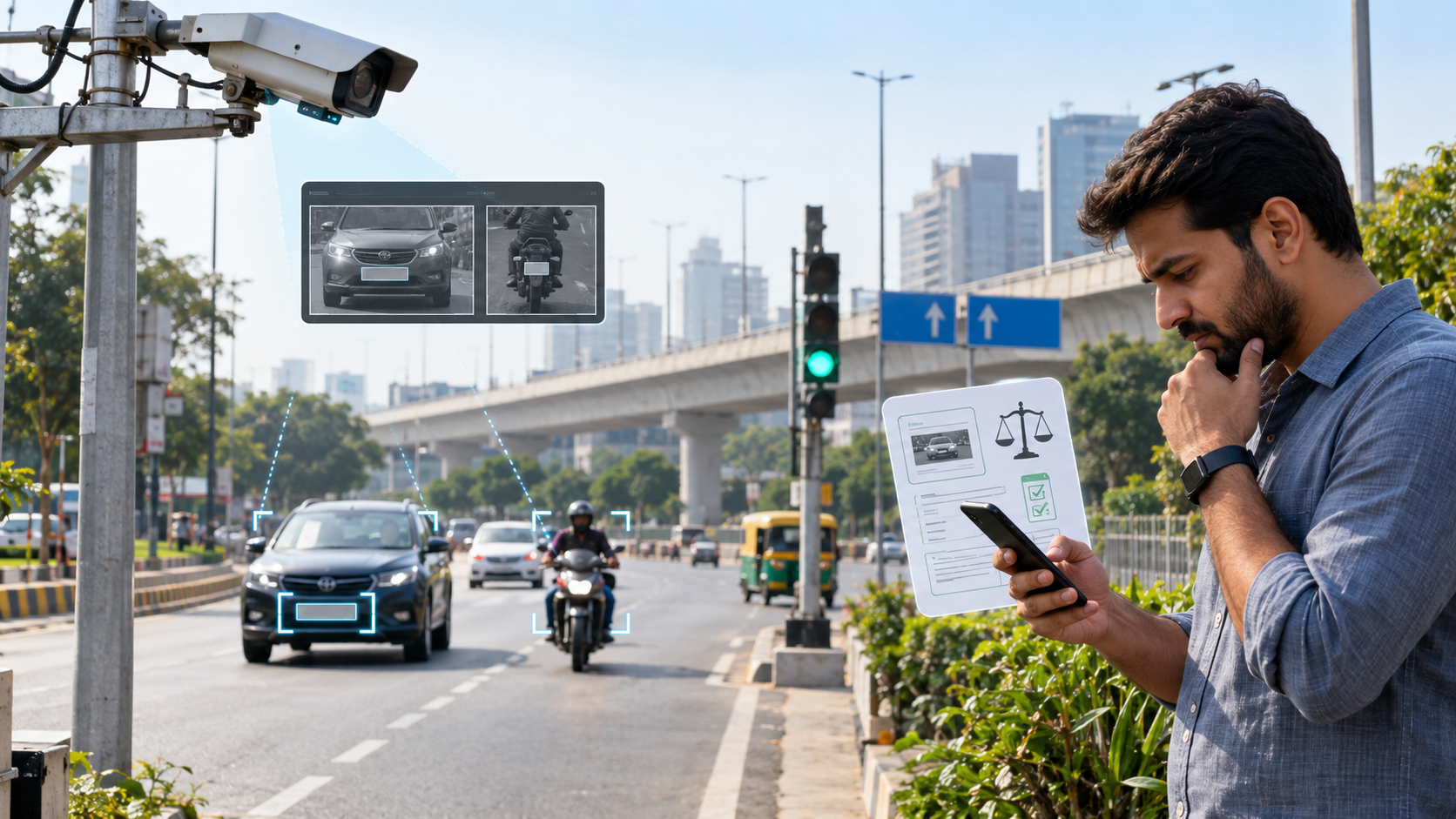
India’s roads are becoming increasingly connected to technology. From speed cameras and CCTV systems to Automatic Number Plate Recognition (ANPR), traffic enforcement is no longer dependent only on officers stopping vehicles at the roadside. A violation can be detected electronically and converted into an e-Challan based on digital evidence.
This raises an important question for vehicle owners: Can an AI or camera-generated traffic challan be challenged if you believe it is wrong?
The answer is yes. A camera-generated challan is not something a vehicle owner should automatically ignore or blindly accept. There is a prescribed process for contesting an unjust challan, and understanding your rights can help you respond appropriately.
How AI and Camera-Based Challans Work
Electronic enforcement devices can capture traffic violations without requiring a traffic officer to physically stop the vehicle. Depending on the system deployed by the relevant authority, these devices may include speed cameras, CCTV cameras, ANPR systems, speed guns and other approved technologies.
The technology can be used to detect violations such as:
- Exceeding the prescribed speed limit
- Jumping a red light
- Stopping or parking at an unauthorised location
- Not wearing a seat belt
- Helmet-related violations
- Certain dangerous driving offences
- Other electronically detectable motor vehicle violations
The information can then be used to generate an electronic challan against the vehicle or driver.
Does a Camera-Generated Challan Automatically Mean You Are Guilty?
Not necessarily.
The existence of a digitally generated challan does not remove the ability to question an incorrect record. Electronic enforcement is intended to create a reliable record of a violation, but mistakes can still arise from incorrect number-plate recognition, technical problems, inaccurate information, or circumstances that require further explanation.
The government has specifically provided a mechanism for contesting challans. Under the amended Central Motor Vehicles Rules, a person receiving a challan can either accept it and pay or contest it through the designated portal by providing supporting documentary evidence.
This makes verification particularly important when a vehicle owner believes that the recorded offence does not accurately reflect what happened.
What Evidence Should You Check?
Before challenging a camera-generated challan, examine the information associated with it carefully.
Look for:
- Vehicle registration number
- Date of the alleged violation
- Time of the incident
- Location
- Type of offence
- Photographic evidence
- Measurement recorded by the electronic enforcement device
- Applicable legal provision
Electronic challans generated through the prescribed enforcement system are required to contain specified information, including photographic evidence highlighting the offence and licence plate, relevant measurements where applicable, and the date, time and place of the offence.
If any information appears inconsistent, preserve the details before taking further action.
When Might a Camera Challan Be Disputed?
A dispute should be based on genuine grounds rather than simply a desire to avoid paying a fine.
Possible situations may include:
- Wrong Vehicle Identification: A camera or number-plate recognition system may incorrectly associate an offence with your vehicle.
- Incorrect Location or Timing: If the recorded location or time does not match your vehicle's actual movement, relevant evidence may help explain the discrepancy.
- Duplicate Challan: The same incident may appear more than once. Checking the challan history can help identify duplication.
- Unclear Evidence: If the available image does not clearly establish the vehicle or alleged violation, the circumstances may warrant review.
- Technical or Record Errors: Incorrect data entry or technical issues can sometimes create inconsistencies in electronic records.
The strength of a dispute ultimately depends on the facts, evidence, applicable rules, and decision of the competent authority.
How to Challenge an Incorrect e-Challan
The Central Motor Vehicles Rules provide a defined timeline for contesting a challan. Under the current provisions, the person to whom a challan is issued has 45 days from the date of issuance to either accept and pay it or contest it on the designated portal with supporting documentary evidence, in accordance with the procedure specified by the State Government.
The practical approach is to:
- Locate and verify the challan.
- Review the available violation evidence.
- Identify the specific reason for disagreement.
- Collect documents or other relevant evidence.
- Submit the dispute through the designated mechanism.
- Keep records of the complaint and supporting material.
- Monitor the outcome of the dispute.
The official e-Challan system also provides grievance functionality for raising issues associated with challans.
What Happens After You Contest It?
The authority is required to consider the submission and supporting documentary evidence. If the challan is quashed, it ceases to have effect and the relevant order is uploaded to the portal.
If the authority rejects the challenge with reasons recorded in writing, the rules provide further options, including payment within the prescribed period or filing an application before the appropriate court, subject to the applicable procedure.
Therefore, submitting a dispute is not simply about sending a complaint and forgetting about it. The subsequent decision and available legal remedies also matter.
Do Not Ignore a Challan Just Because You Think It Is Wrong
One of the biggest mistakes a vehicle owner can make is ignoring an electronic challan.
The current rules provide a specific period for contesting it. If the challan is not contested within the prescribed 45-day period, it is deemed to have been accepted after that period, followed by the applicable payment timeline.
This makes timely action important.
If you believe a challan is incorrect, gather your evidence and use the prescribed process rather than simply leaving the notice unresolved.
Protect Yourself From Fake Challan Messages
Digital enforcement has also created opportunities for fraudsters to impersonate official challan services.
The official e-Challan portal warns users about fraudulent websites and mobile applications impersonating e-Challan services. It advises users to access the official service and cautions that the system does not request passwords, OTPs, payment details, or sensitive personal information through calls, emails, messages, or suspicious links.
Vehicle owners should therefore verify the source of any challan communication before clicking payment links or sharing personal information.
When Should You Seek Legal Assistance?
A straightforward challan may be resolved through the prescribed online process. However, professional legal assistance can become useful when the matter involves disputed evidence, repeated violations, serious offences, vehicle seizure, licence-related consequences, or court proceedings.
A legal professional can help assess the available evidence, explain the applicable provisions, and determine whether challenging the challan is appropriate.
Final Takeaway
AI traffic cameras and electronic enforcement are changing how traffic violations are detected in India. A camera-generated challan can be an important piece of enforcement evidence, but receiving one does not mean that a genuine error cannot be questioned.
If you believe a challan is incorrect, check the evidence, collect supporting documents, and use the prescribed grievance or contest mechanism within the applicable timeframe. The current Central Motor Vehicles Rules specifically provide a process for contesting challans, making timely action essential.
For official challan verification and related services, vehicle owners should use the government’s e-Challan system rather than unverified websites or payment links.
